
CLI & Configuration
Click commands, modular defaults, manifests, profiles, evaluator settings, and resource-control presets.
DeepBuilder is an end-to-end autoresearch agent framework for productive, stable, and goal-aligned research over hours or days. The current implementation centers on a recoverable executable workspace: agents inspect task data, write and run code, evaluate candidate artifacts, preserve validated stages, reconsider research direction, and resume interrupted work without discarding established evidence.
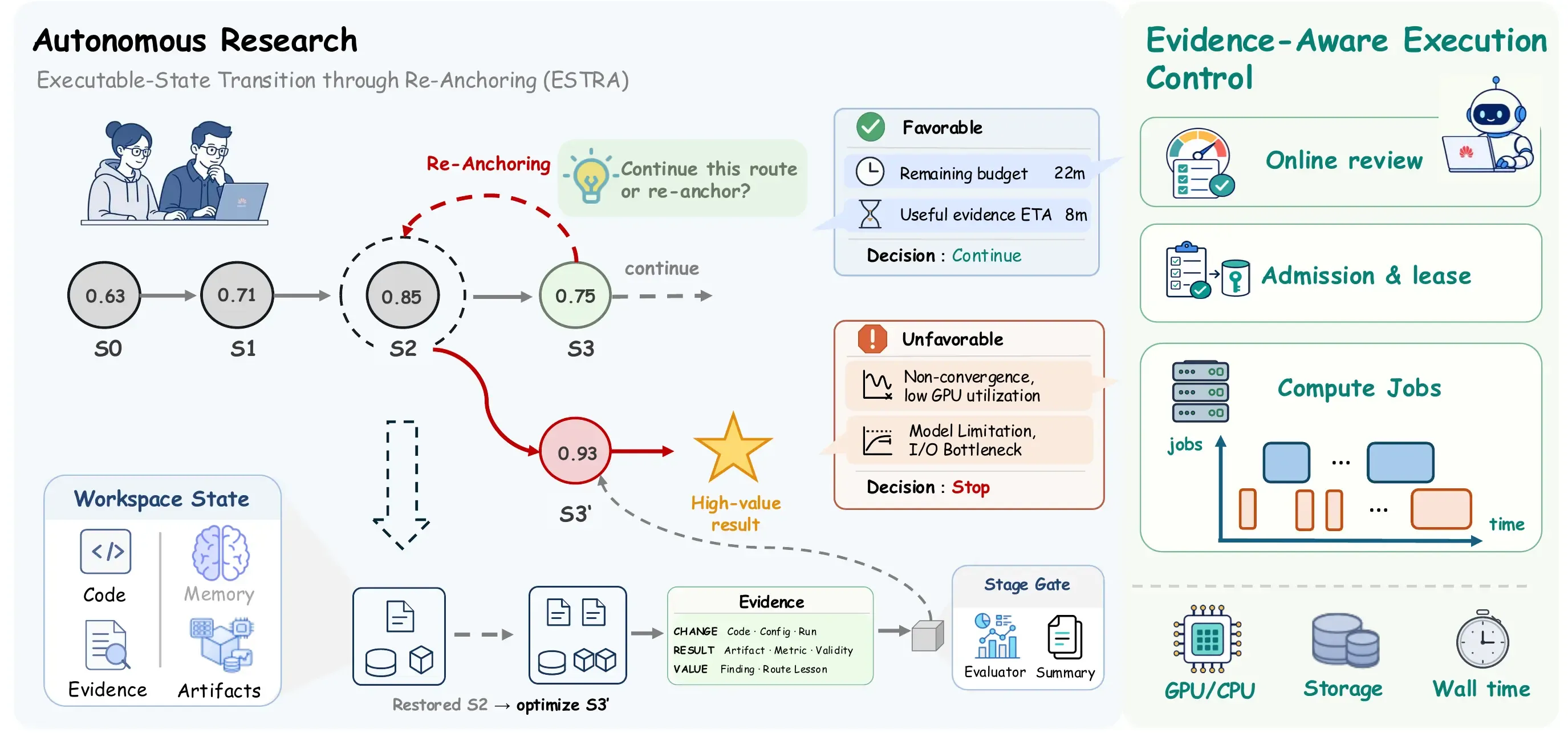
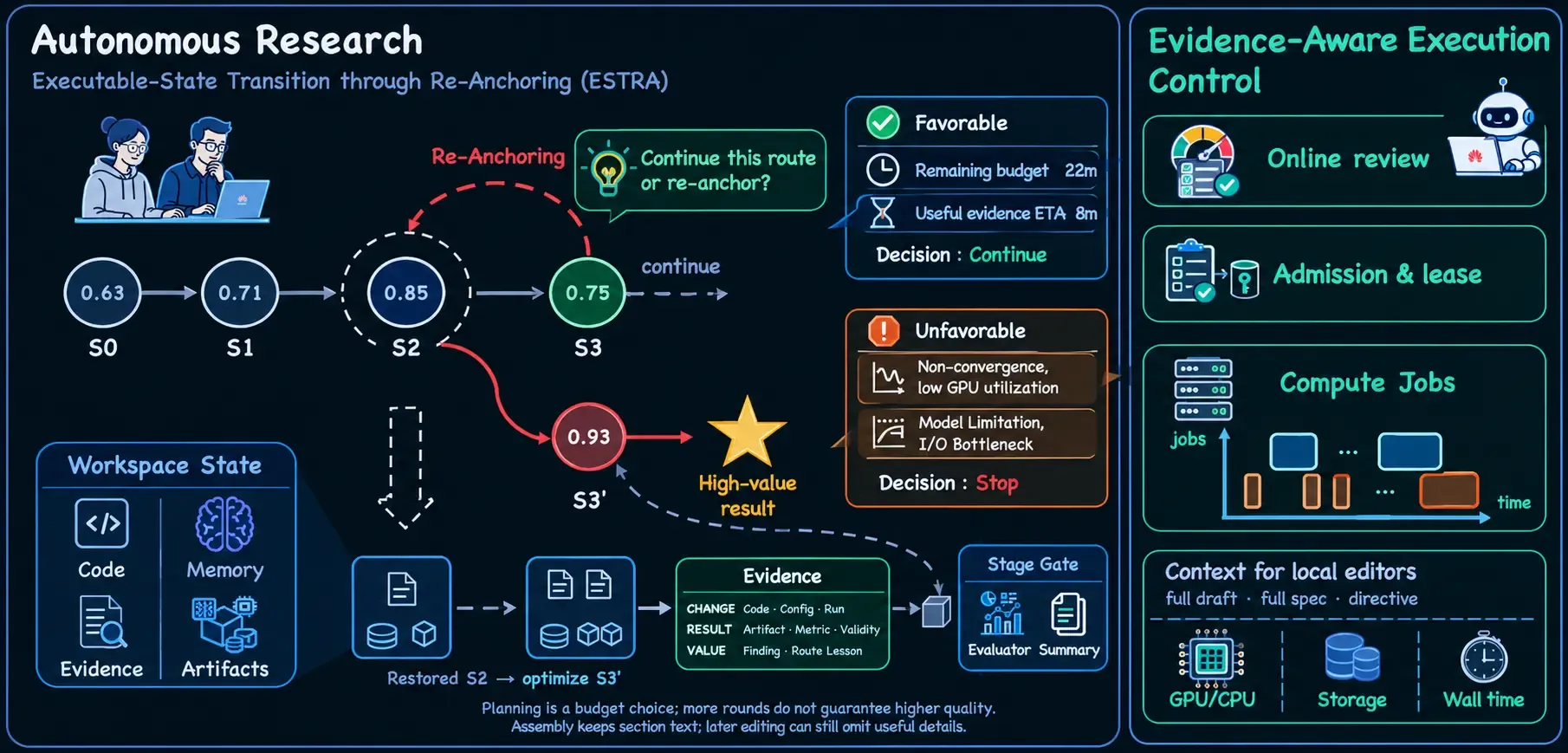
DeepBuilder system architecture. Research workers operate over recoverable executable states and adapt long-horizon trajectories through boundary-triggered ESTRA transitions, while evidence-aware execution control coordinates physical resource allocation and runtime execution.
Across machine learning, scientific modeling, and mathematical optimization, DeepBuilder sustains effective long-horizon research and reaches 70.22 ± 1.18% Any-Medal on the full 75-task MLE-bench within a 24-hour budget, exceeding the strongest reported baseline by 5.78 percentage points.
The same runtime supports each of these domains. Task-specific artifact schemas and metrics live in registered task packages, while the core runtime remains task-domain agnostic.
To install DeepBuilder via pip and open the terminal interface:
pip install deepbuilderdeepbuilder config initdeepbuilder tuiSee Getting Started for model setup and a first task, and the Runtime Guide for running, monitoring, and resuming research.
Resource control runs alongside this flow. Bash jobs publish execution facts to a task-local runtime that manages CPU boundaries, GPU leases, queues, monitored trials, review state, bounded timeboxes, and guarded intervention. The control plane manages execution opportunity and efficiency; the research agent remains responsible for scientific route selection.
CLI & Configuration
Click commands, modular defaults, manifests, profiles, evaluator settings, and resource-control presets.
Data Preparation
Agent-driven preparation of a flat dataset/ view and auditable train/validation split artifacts.
Core Runtime
Orchestration, task packages, parallel task isolation, model routing, tracing, and process cleanup.
Agent & Tools
The DeepAgent run loop, tool execution, workspace guards, output compression, and memory projection.
LNR Solver
Long-horizon workers, Stage transactions, snapshots, ESTRA, stage-memory folding, resume, and final merge.
Resource Management
Task-local admission, lease and queue control, review state, advisory, arbiter, strict gate, and feedback hygiene.
Skills & Safety
Markdown skill discovery plus execution, code, leakage, stdout, and resource safety evidence.
Selection & Observability
Stage/evaluator/resource event stores, score summaries, monitors, traces, and finals.
Task Onboarding
The current task-package contract for optimization and scientific-modeling tasks.
deepbuilder/├── deepbuilder/│ ├── agent/ # DeepAgent runtime, factory, policies, prompts, sessions│ ├── foundation/ # Configuration, versioned contracts, architecture rules│ ├── interfaces/ # CLI, TUI, Web monitor, Rich monitor, trace renderer│ ├── research/│ │ ├── solver/lnr/ # Long-horizon runtime, stages, ESTRA, resume, resources│ │ ├── quality/ # Evaluators, Gate policies, assessment, finalization│ │ ├── state/ # Ledger, stage memory, and skill catalog│ │ ├── control/ # Managed research control and admission│ │ └── reporting/ # Markdown and HTML task reports│ └── runtime/ # Orchestration, parallel tasks, safety, observability├── tasks/│ ├── ml/mlebench/ # MLE-bench task packages│ ├── opt_solver/ # Optimization task packages│ └── sci_modeling_bench/ # Scientific-modeling task packages├── skills/ # Built-in Markdown skill library└── docs/ # This documentation site| Contract | Current implementation |
|---|---|
| Task identity | tasks/**/task.yaml declares task id, category, provider/profile, description, artifact, metric, evaluator, and optional Gate policy. |
| Candidate admission | deepbuilder/research/quality/assessment/ owns evaluation and policy application through GateManager. Primary mode fails closed on missing, duplicate, or invalid outcomes. |
| Validated progress | An accepted candidate is recorded in the hidden ledger, materialized as a Stage, captured in a workspace snapshot, and summarized in task_logs/lhr_stage_performance.csv. |
| Long-term memory | The append-only ledger remains the source of truth. research/state/knowledge/memory/records/stage_memory.py folds older cards into persistent summaries while retaining recent and verification-critical raw cards. |
| Recovery | Task resume reuses the workspace and budget state; agent resume reloads persisted memory; a single pending tail tool call can be replayed directly. |
| Finalization | research/quality/finalization/ evaluates worker evidence and writes one or more final directories under merge/finals/final_*. |
| Reporting | research/reporting/ writes report.md, report.html, report.json, and report_assets/ in the task directory under a separate report budget; earlier attempts stay under task_logs/reports/attempt-NNN/. |
task_root/├── report.md├── report.html├── report.json├── report_assets/├── task_logs/│ ├── lhr_stage_performance.csv│ ├── lhr_events.jsonl│ ├── state.json│ ├── reports/attempt-NNN/│ └── resource/resource_events.jsonl├── workers/│ └── w00/│ ├── workspace/│ ├── snapshots/│ └── logs/│ ├── evaluator_events.jsonl│ └── deepbuilder_time_trace.csv└── merge/ ├── global_merge_manifest.json └── finals/final_*/